


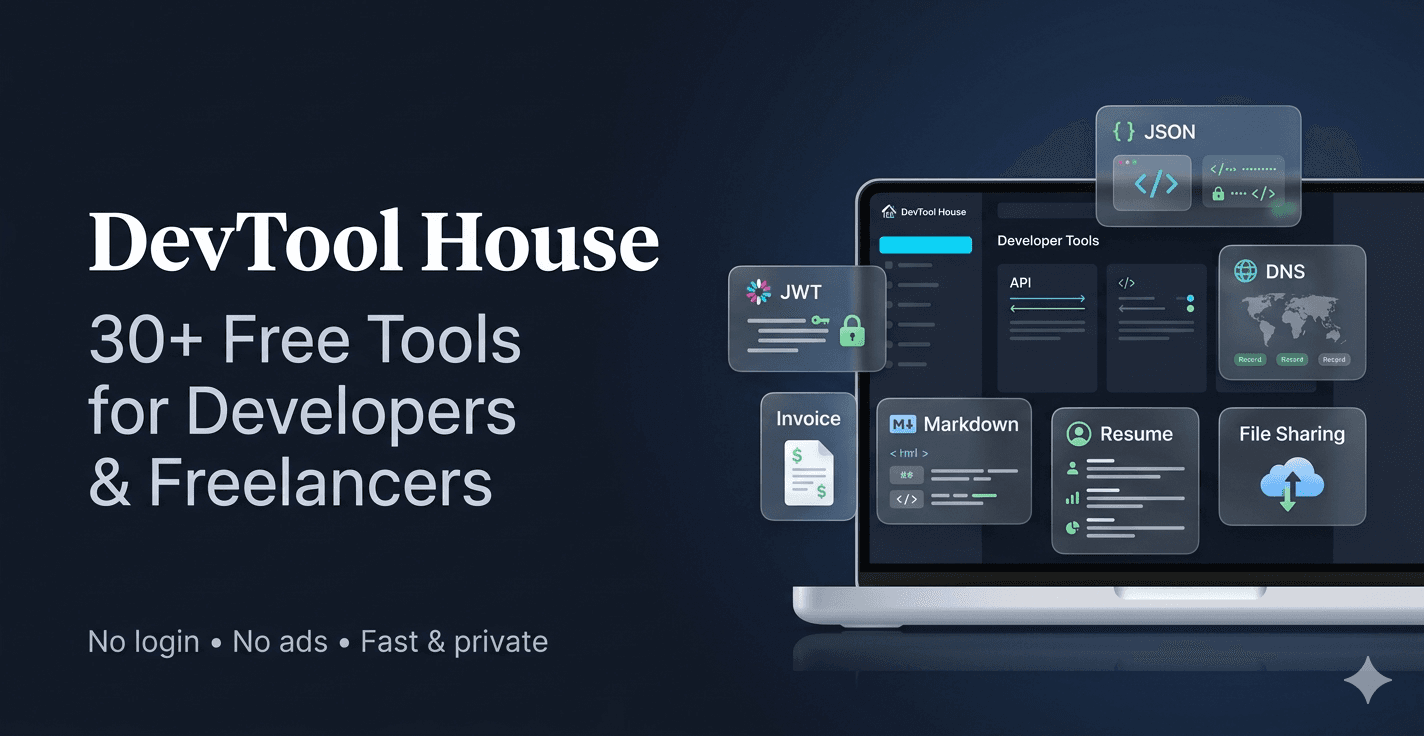
Built for developers who would rather not paste a token into a stranger’s server.
DevTool House is Wali Ullah’s open-source project, built and maintained by an engineer on the Deknows team. We show it here because it evidences how our engineers build — not because it is a company product.
The problems DevTool House was built for

Tab sprawl
A JSON formatter on one site, a JWT decoder on another, a cron parser somewhere else entirely.

Signup walls
A tool that wants an account and an email address before it will format a string for you.

Ads around your data
Utilities wrapped in advertising, where the input you paste is quietly the actual product.

Silence about storage
You paste a token and nothing on the page tells you what happens to it afterwards.

Moving files between devices
The everyday laptop-to-phone transfer that still ends up as emailing yourself an attachment.

Local tooling gaps
Freelancers doing tax, invoicing and rate maths by hand because nothing covers their region.

How DevTool House Works

Open a tool and use it
No login, no install, no rate limits. Every tool is directly reachable and works on first load.
Input is processed, not kept
Requests are handled server-side in milliseconds and nothing is stored. Your code and tokens never outlive the request.
DevSavr moves files between devices
Create a room, get a six-character code, join from a phone by code or QR. Text and files sync live across every device.
Rooms expire on their own
Files up to 100 MB, rooms gone in five to sixty minutes. Privacy by expiry rather than by policy.
What DevTool House Covers
How It Was Built
Discipline in what was left out

The toolkit is straightforward engineering done carefully. The interesting decisions were all subtractions — no accounts, no storage, no premium tier to design around.
No persistence to leak
Processing happens server-side within the request. With no account system there is no record to attach an input to in the first place.
Real-time sync in DevSavr
WebSocket sync across arbitrary devices, ephemeral rooms keyed by a six-character code, transfers up to 100 MB.
Removing the annoying step
Joining by QR removes the one genuinely irritating part of cross-device transfer, which is typing anything at all on a phone.
Honest about its limits
Transfers use HTTPS but are not end-to-end encrypted, and the product says so in the product rather than in a footnote.
What This Proves
- Real-time systems over WebSockets
- Privacy-by-design as an architecture, not a policy
- Performance measured in milliseconds
- Open-source engineering held to public scrutiny
- The calibre of the engineers on our team
Who DevTool House Is For



Using DevTool House
Free and open source. No signup, no rate limits, no premium tier — and the source is public if you would rather run it yourself.
Free Tools
DevSavr Transfers
Accounts Required
The services this proves out
We built DevTool House with the same team and the same practices we bring to client work.
Engage & Acknowledge from the Digital Sphere


FAQS
Common questions about DevTool House.
No. Input is processed server-side within the request and nothing is persisted. There is no account system, so there is no record to attach your input to in the first place.
Transfers run over HTTPS and rooms expire automatically between five and sixty minutes, but they are not end-to-end encrypted. Treat it as convenient for ordinary files, not as a channel for secrets.
All 32+ tools, no signup, no rate limits, no premium tier. It is open source, which is also the honest answer to what happens if it stops being maintained.
It is Wali Ullah’s open-source project — he is an engineer on our team. We show it here because it evidences how our engineers build, not because Deknows owns or sells it.
Want something like DevTool House?
The engineering behind our own products is the engineering we bring to yours. Tell us what you are trying to build.